Llamafile: Run Any LLM Locally With a Single File, No Installation Required (2026 Guide)
Llamafile bundles the inference engine, web UI, API server, and model weights into one portable executable that runs on Windows, Mac, and Linux. Free, open source, zero install.
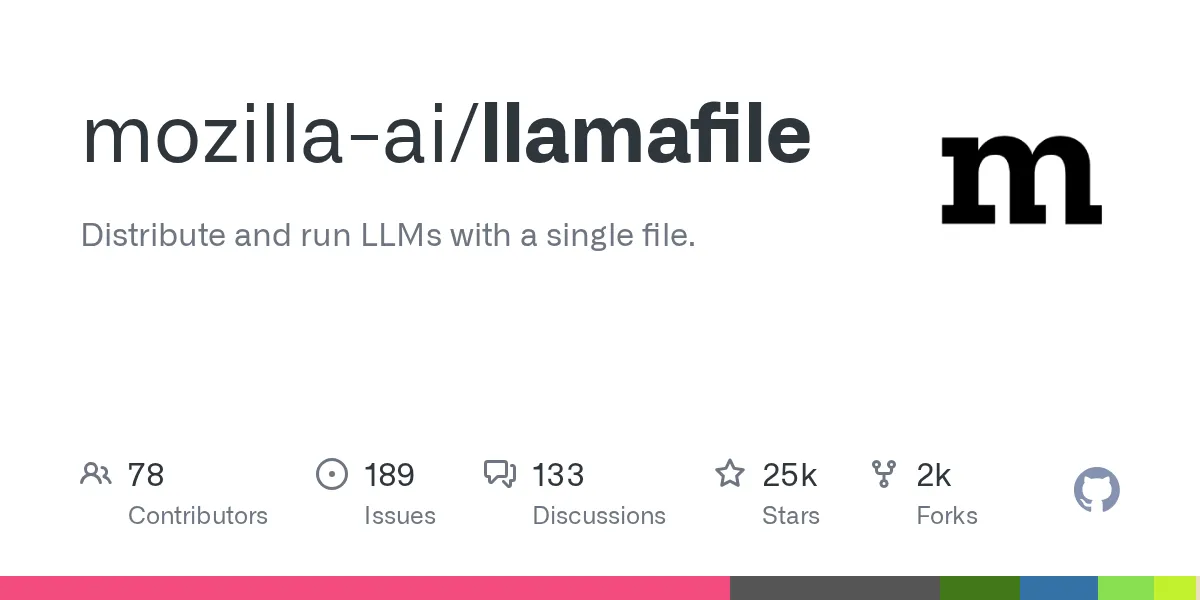
Running large language models locally has always been complicated. You install Python, configure GPU drivers, set up an API server, download multi-gigabyte model weight files, and pray the dependencies don't conflict. If you want to share that setup with a coworker or ship it inside a software product, cross-platform compatibility becomes a nightmare.
Llamafile, spearheaded by Mozilla AI and built on Justine Tunney's Cosmopolitan Libc and the llama.cpp framework, collapses the entire complexity of local LLMs into a single, highly portable executable file. You download one file, make it executable, and run it. The same binary works natively on macOS, Windows, Linux, FreeBSD, OpenBSD, and NetBSD, automatically utilizing whatever GPU or CPU acceleration is available.
In this guide, you'll learn what Llamafile is, who it's for, and how to run your first local LLM in under two minutes with zero installation.
What is Llamafile?
At its core, Llamafile is an innovative distribution method and runtime engine for open source AI models. Traditionally, running an LLM on your local machine required setting up a specialized runtime (like Ollama or LM Studio), configuring GPU drivers, installing API servers, and downloading separate multi-gigabyte model weight files (such as GGUF). If you wanted to share that AI setup with a coworker or ship it inside a software product, compatibility issues across operating systems quickly became a nightmare.
Llamafile solves this by introducing a unified package format called an Actually Portable Executable (APE). It combines the inference engine (llama.cpp), an embedded web-based chat UI, an OpenAI-compatible REST API server, and the actual model weights (GGUF) into one singular file. You download a single file, make it executable, and run it. The exact same binary natively executes on macOS, Windows, Linux, FreeBSD, OpenBSD, and NetBSD, seamlessly utilizing whatever GPU (NVIDIA CUDA, Apple Metal, or AMD ROCm) or CPU acceleration is available on the host machine.
Who is it for?
- Privacy-conscious developers and researchers: Anyone who needs to process sensitive corporate documents, proprietary code, or personal data locally without sending telemetry or prompts to third-party cloud endpoints.
- Software distributors and product teams: Engineers looking to bundle an offline AI assistant directly into their desktop applications, CI/CD workflows, or customer deliverables without requiring users to install Docker or complex dependencies.
- Educators and workshop facilitators: Trainers who need to distribute LLMs on USB drives at conferences, air-gapped facilities, or classrooms where bandwidth is limited and setup time must be near zero.
- AI hobbyists and tinkerers: Users who want a friction-free, lightweight way to experiment with open source models like Llama, Mistral, Gemma, or Qwen without dedicating permanent system background services.
What makes Llamafile different from other local LLM tools?
- Actually Portable Executable (APE): Thanks to Cosmopolitan Libc, a Llamafile is simultaneously a valid Windows PE binary, a Linux ELF binary, a macOS Mach-O executable, and a POSIX shell script. One file truly runs everywhere.
- Zero-install architecture: There are no daemons to install, no background services to register, and no client-server setups to manage. You literally just click or execute the file from your terminal.
- Automatic hardware acceleration: Llamafile dynamically detects your system architecture at runtime. It automatically compiles and hooks into Apple Metal on Macs, NVIDIA CUDA on supported rigs, or AMD ROCm on Linux and Windows, falling back gracefully to optimized CPU vector instructions (AVX2/ARM64) if a GPU is absent.
- Built-in OpenAI-compatible server: Out of the box, executing a Llamafile spins up a local web server (usually on port 8080) featuring a full chat playground UI and a standard REST API endpoint (
/v1/chat/completions), allowing you to drop it directly into existing LangChain, LlamaIndex, or custom AI codebases. - Memory-mapped loading (mmap): By utilizing fast mmap file access, Llamafile loads multi-gigabyte models into system RAM almost instantaneously without duplicating memory overhead.
- Free and open source: The entire project is free and open source under Apache 2.0 and MIT licenses. No subscription, no telemetry, no vendor lock-in.
What you need before you start
Because Llamafile is completely self-contained, software prerequisites are minimal. However, your hardware must be capable of holding the neural network weights in memory:
- Operating system: macOS (10.13+), Windows 10/11, Linux (kernel 2.6.18+), or modern BSD distributions.
- System RAM / VRAM: At least 8 GB of unified RAM/VRAM for small models (1B to 3B parameters) and 16 GB+ for 7B to 8B models. For smooth execution, your free RAM should exceed the file size of the Llamafile by at least 2 to 4 GB.
- Storage: An SSD with sufficient free space to store the downloaded
.llamafile(ranging from 1.5 GB to 20+ GB depending on model quantization). - Windows specifics: Due to legacy Windows filesystem limitations, executable files larger than 4 GB cannot run natively as a standalone
.exe. For models exceeding 4 GB on Windows, you will use the split engine and weights method detailed in Step 4 below.
Step-by-step installation
Step 1: Download your first Llamafile
Navigate to Mozilla AI's official model repository on Hugging Face or their GitHub releases page. For this guide, we will download a lightweight model. You can use your web browser or grab it directly via your terminal:
curl -LO https://huggingface.co/mozilla-ai/llamafile_0.10/resolve/main/Qwen3.5-0.8B-Q8_0.llamafile
Step 2: Make the file executable (macOS / Linux / BSD)
By default, UNIX-based operating systems download files without execution permissions for security reasons. You need to grant execution permission using the chmod command. Windows users can skip this step and simply rename the file extension to .exe (for example, Qwen3.5-0.8B-Q8_0.exe).
chmod +x Qwen3.5-0.8B-Q8_0.llamafile
Step 3: Run the Llamafile server and UI
Now, execute the file from your terminal. When launched without arguments, Llamafile will load the model weights into your system RAM/VRAM, spin up a local HTTP server, and automatically launch your default web browser to display the built-in chat UI.
# Launch the Llamafile (macOS / Linux)
./Qwen3.5-0.8B-Q8_0.llamafile

# On Windows, run via Command Prompt or PowerShell:
.\Qwen3.5-0.8B-Q8_0.exe
Once running, point your browser to http://localhost:8080 if it does not open automatically. You can now chat with the model directly in the web UI.
Step 4: Running larger models on Windows (the 4GB limit)
Because native Windows prevents executables larger than 4 GB from running directly, running massive models (like 8B, 14B, or 70B parameters) on Windows requires separating the lightweight Llamafile engine from the GGUF model weights. Download the standalone llamafile-server binary and your desired .gguf file separately, then link them via flags:
.\llamafile-server.exe -m my-large-model-Q5_K_M.gguf -ngl 999 -c 8192
Step 5: Interacting via API or CLI mode (advanced)
If you want to use Llamafile as a headless backend for your Python scripts or interact with it purely in the terminal without spawning a web server, you can pass runtime flags:
# Run in CLI mode for instant terminal chat completion
./Qwen3.5-0.8B-Q8_0.llamafile --cli -p "Explain the theory of relativity in one sentence:"

# Run in headless server mode (no browser popup, custom port)
./Qwen3.5-0.8B-Q8_0.llamafile --server --nobrowser --port 8080
Common errors and how to fix them
| Error | What it means | How to fix it |
|---|---|---|
| "Permission denied" or "command not found" | The operating system does not recognize the downloaded file as an executable binary. | Run chmod +x filename.llamafile on macOS/Linux. Ensure you prefix the command with ./ when executing in your current directory. |
| "Program too big to fit in memory" (Windows) | You are trying to run a single Llamafile executable larger than 4 GB on Windows, hitting the OS executable limit. | Rename the file with an .exe extension if under 4 GB. For files over 4 GB, download the external .gguf weights and launch using the lightweight llamafile-server.exe binary. |
| "Out of memory (OOM)" / process killed | Your system RAM or GPU VRAM is insufficient to load the requested quantized model weights and context window. | Close memory-heavy background applications, reduce the context window using the -c 2048 flag, or download a smaller quantized model (for example, Q4_K_M instead of Q8_0 or FP16). |
| "libstdc++.so.6 version not found" (Linux CUDA) | Your Linux system's GNU C++ library is older than the compiler version required for dynamic CUDA linking. | Update your system's libstdc++ via your package manager, update your NVIDIA CUDA toolkit, or let Llamafile fall back to CPU vector inference by appending -ngl 0. |
| "Address already in use (Port 8080)" | Another local service or previous LLM instance is currently occupying HTTP port 8080. | Terminate the conflicting process, or launch Llamafile on an alternative port by passing the flag --port 8081. |
Llamafile vs commercial cloud LLMs
| Feature | Llamafile (free and open source) | Commercial cloud LLMs (OpenAI, Anthropic) |
|---|---|---|
| Data privacy and security | 100% local. No prompts, documents, or data ever leave your physical device. Zero telemetry. | Data is transmitted over the internet to remote servers, subject to cloud provider retention policies. |
| Cost structure | Completely free forever (Apache 2.0 / MIT licenses). Your only cost is your own local electricity and hardware. | Pay-per-token API usage fees or recurring monthly subscription tiers ($20 to $200+/month). |
| Offline availability | Fully functional without internet. Ideal for airplanes, secure labs, or remote locations. | Requires a continuous, high-speed internet connection to operate. |
| Setup and portability | Single executable file that runs across Windows, Mac, and Linux without installation or dependencies. | Requires API key generation, network authentication, and client SDK integration. |
| Model capability and scale | Limited by your local machine's RAM/VRAM (best for 1B to 32B parameter models). | Access to massive 1+ trillion parameter frontier models running on multi-million dollar GPU clusters. |
| Best for | Privacy, portability, offline use, and distribution | Maximum model quality and scale |
Bottom line: Llamafile is the ultimate equalizer for local AI deployment. By condensing the entire LLM software stack into a single, universal executable that runs natively on any operating system, it eliminates the friction of local AI adoption and gives developers, researchers, and hobbyists complete data sovereignty without sacrificing convenience or performance. If you've ever wanted to run an LLM locally but were intimidated by the setup, Llamafile is the easiest starting point available.
3 alternatives worth checking out
- Ollama (ollama.com): Currently one of the most popular local LLM managers. While Llamafile bundles models into individual standalone executables, Ollama operates more like Docker for AI, running a background daemon and allowing you to pull, swap, and manage multiple models via simple terminal commands (for example,
ollama run llama3). It is better suited for users who want to frequently switch between dozens of different models on a single machine, though it requires a standard software installation. - LM Studio (lmstudio.ai): Provides a rich, polished desktop graphical user interface for discovering, downloading, and running GGUF models locally on Windows, Mac, and Linux. Unlike Llamafile's lightweight, file-based approach, LM Studio is a full-weight desktop application featuring advanced chat management, visual hardware monitoring, and an easy model search browser powered by Hugging Face.
- Jan AI (jan.ai): An open-source, privacy-first desktop application designed as an offline alternative to ChatGPT. Like LM Studio, it offers a clean, user-friendly graphical interface and a local OpenAI-compatible API server. While Jan is fantastic for everyday desktop chatting without command-line interaction, Llamafile remains unbeatable when you need a portable, zero-install binary to distribute within scripts or software bundles.
Found this guide useful? Check out more AI tools and free tools for developers on Sudo Scout.
Related posts
Prime Agent: The Self-Improving AI Coding Agent With Persistent IPython and Built-In Subagents (2026 Guide)
Prime Agent is a free, open source self-improving RLM agent for coding and long-running autonomous tasks. Persistent IPython, built-in subagents, continual harness refinement, daemon-backed sessions. 15.8K stars.
NVIDIA Switchyard: Route LLM Traffic Across Models and Providers Without Changing Your API (2026 Guide)
NVIDIA Switchyard is a free, open source Rust proxy that routes LLM requests across providers. Translates between OpenAI and Anthropic APIs, supports Claude Code and Codex, A/B benchmarking, cost optimization. Apache 2.0.
Needle 2: The 14MB AI Model That Runs on Phones, Wearables, and Smart Home Devices (2026 Guide)
Needle 2 is a free, open source 45M-parameter foundation model for tool calling on tiny devices. 14MB binary, 28MB RAM, runs fully offline. LoRA fine-tuning, confidence gating, structured extraction. 5.4K stars.